Overview
DRD Guardian Suit is an advanced research and development initiative by D.R.D Security Pvt. Ltd., developed under the D.R.D Revolution Wing. The project explores the future of AI Powered Exoskeleton Suit technologies through responsible engineering, wearable robotics research, and intelligent human-machine collaboration.
The Guardian Suit program is focused on evaluating next-generation concepts that may enhance human mobility, operational efficiency, situational awareness, and mission adaptability. As a multidisciplinary research platform, it combines knowledge from artificial intelligence, robotics, electronics, materials science, and digital engineering while maintaining a strong emphasis on safety, ethics, and responsible innovation.
The project is intended as a long-term research initiative that will continue to evolve alongside advancements in wearable technology and intelligent systems.
Vision
Our vision is to contribute to the future of wearable intelligent systems through continuous research, engineering excellence, and responsible innovation.
The Guardian Suit is envisioned as a research platform that explores how advanced technologies can support human performance while maintaining safety, reliability, and operational flexibility.
Key Highlights
- AI Powered Exoskeleton Suit research
- Wearable robotics innovation
- Human performance enhancement research
- Intelligent assistance concepts
- Smart situational awareness
- Modular research architecture
- Ergonomic design philosophy
- Future-ready software framework
- Advanced engineering research
- Scalable technology platform
- Human-machine collaboration studies
- Continuous innovation approach
Research Focus Areas
The Guardian Suit program brings together multiple areas of scientific and engineering research, including:
- Artificial Intelligence
- Robotics
- Wearable Technologies
- Mechanical Engineering
- Electronics Engineering
- Embedded Systems
- Materials Engineering
- Human Factors Engineering
- Computer Vision
- Sensor Integration
- Cybersecurity
- Digital Engineering
- Human–Machine Interaction
- Intelligent Decision Support
The objective is to develop a flexible research platform capable of supporting future innovation while protecting proprietary research and intellectual property.
Research Objectives
The Guardian Suit initiative is focused on exploring future concepts related to wearable intelligent systems.
Current research areas include:
- Human mobility enhancement
- Intelligent assistance concepts
- Situational awareness research
- Wearable sensing technologies
- Ergonomic engineering
- Future human-machine collaboration
- Intelligent operational support
- Modular system research
- Smart software integration
- Sustainable engineering practices
Specific implementation methodologies remain confidential.
AI Powered Exoskeleton Suit Research
Artificial Intelligence is one of the primary research domains within the Guardian Suit program.
Research activities include high-level exploration of:
- Intelligent decision support
- Context-aware assistance
- Operational analytics
- Adaptive user interaction
- Human-centered automation
- Predictive maintenance concepts
- Intelligent system monitoring
- Software-assisted operational workflows
Technical algorithms, software architecture, and implementation methods are proprietary and are not publicly disclosed.
Human-Machine Collaboration
The Guardian Suit research program investigates how wearable intelligent systems may improve collaboration between humans and advanced technologies.
Research focuses on:
- Natural interaction concepts
- User-centric system design
- Situational information presentation
- Intelligent assistance
- Operational awareness
- Future wearable computing
The project is designed to support responsible innovation while maintaining usability and long-term adaptability.
Modular Research Philosophy
Guardian Suit follows a modular research philosophy that encourages continuous improvement and future expansion.
This flexible approach allows new technologies, research concepts, and engineering innovations to be evaluated without requiring complete redesigns as the research program evolves.
Security & Reliability
Security remains a core principle throughout the Guardian Suit research lifecycle.
Research activities emphasize:
- Secure software design
- System reliability
- Data protection
- Operational resilience
- Cybersecurity awareness
- Responsible engineering
- Safety-first development philosophy
Detailed security mechanisms and engineering processes remain confidential.
Innovation Philosophy
Guardian Suit is designed as an evolving research platform rather than a fixed product.
Its purpose is to support long-term innovation across wearable robotics, intelligent systems, artificial intelligence, and advanced engineering while encouraging multidisciplinary collaboration and continuous research.
The platform will continue to evolve as new technologies become available and research progresses.
Research Status
DRD Guardian Suit is currently an active research and development initiative.
Research objectives, visual concepts, engineering studies, and future capabilities may evolve as development continues.
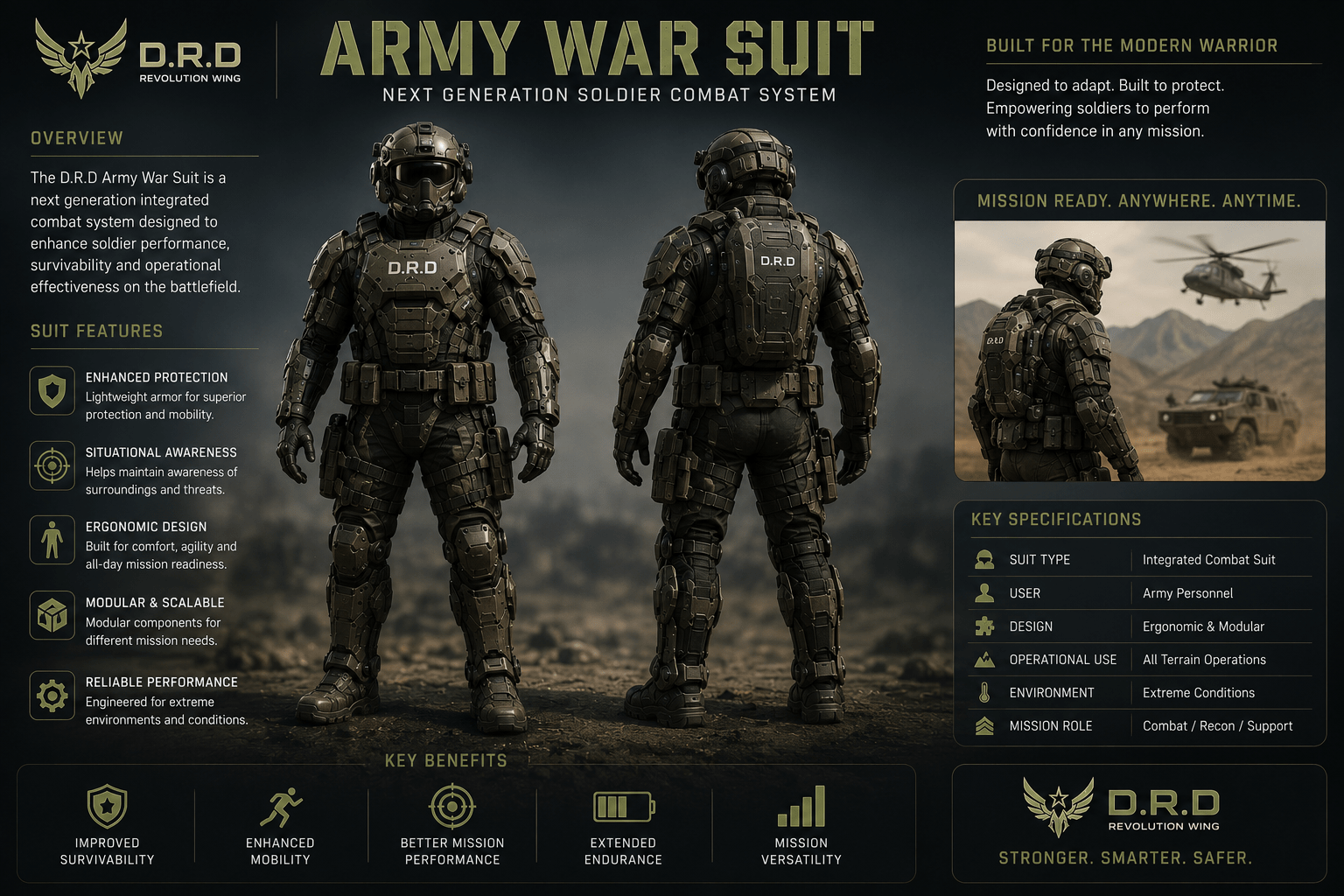
Images and illustrations published on this website are conceptual representations intended to communicate the project’s research vision. They should not be interpreted as finalized engineering designs or production specifications.
Intellectual Property Notice
The DRD Guardian Suit program, associated concepts, branding, visual designs, documentation, and research materials are proprietary assets of D.R.D Security Pvt. Ltd.
To protect ongoing research and future intellectual property, certain information has intentionally been omitted from public documentation, including:
- Engineering methodologies
- Software architecture
- Control logic
- Mechanical design methods
- Manufacturing techniques
- Material specifications
- Embedded system implementation
- Electronics architecture
- Sensor integration methods
- Internal research documentation
- Performance optimization methods
- Testing methodologies
- Proprietary workflows
Unauthorized reproduction, reverse engineering, commercial use, or distribution of proprietary research materials without written authorization from D.R.D Security Pvt. Ltd. is prohibited.
Learn More
Discover additional research initiatives developed by D.R.D Security:
Industry References
Readers interested in wearable technologies, defence research, and engineering innovation may explore information published by official organizations such as:
- Defence Research and Development Organisation (DRDO)
- Ministry of Defence, Government of India
- Directorate General of Quality Assurance (DGQA)
These organizations provide valuable insights into research, engineering standards, and technology development.
About D.R.D Revolution Wing
The D.R.D Revolution Wing is the advanced research and innovation division of D.R.D Security Pvt. Ltd.
The division is dedicated to multidisciplinary research across:
- Artificial Intelligence
- Cybersecurity
- Robotics
- Wearable Technologies
- Aerospace Engineering
- Autonomous Systems
- Digital Engineering
- Advanced Computing
- Emerging Technologies
Through responsible innovation and collaborative engineering, the Revolution Wing aims to contribute to the development of future technology platforms while fostering research excellence and protecting intellectual property.
Disclaimer
DRD Guardian Suit is an active research and development initiative. All information presented on this page is intended for educational and informational purposes only. Certain engineering methodologies, technical specifications, implementation strategies, software architecture, manufacturing processes, operational concepts, and other proprietary information have been intentionally omitted to safeguard confidential research, trade secrets, and future intellectual property rights. Visual representations are conceptual and may evolve as research progresses.